
Hep2 Cell Patterns
Hep2 Cell Patterns - Web it allows detection of antibody binding to specific intracellular targets, resulting in diverse staining patterns that are usually categorized based on the cellular components recognized and the degree of binding, as reflected by the fluorescence intensity or titer [ 2, 3 ]. Nuclear homogeneous, nuclear coarse speckled, and nuclear centromeric patterns appeared exclusively in patients with ards. Web the ana pattern profile was distinct in the 2 groups. This is a summary of the international consensus on antinuclear antibody pattern (icap) meeting and subsequent discussion, debate, and dialog. Homogenous, speckled, centromere, nucleolar, and nuclear dots. The nuclear dense fine speckled pattern occurred only in healthy individuals. The dichotomous outcome, negative or positive, is integrated in diagnostic and classification criteria for. It still leaves open the question of. Interphase cells show homogeneous nuclear staining while mitotic cells show staining of the condensed chromosome regions. Web assess antinuclear antibody titers and patterns were retrospectively identified and compared by iifa using human epithelial cells (hep‐2) and primate liver tissue substrate according to international consensus in sard. The nuclear dense fine speckled pattern occurred only in healthy individuals. Web assess antinuclear antibody titers and patterns were retrospectively identified and compared by iifa using human epithelial cells (hep‐2) and primate liver tissue substrate according to international consensus in sard. Homogenous, speckled, centromere, nucleolar, and nuclear dots. The dichotomous outcome, negative or positive, is integrated in diagnostic and classification criteria for. Web it allows detection of antibody binding to specific intracellular targets, resulting in diverse staining patterns that are usually categorized based on the cellular components recognized and the degree of binding, as reflected by the fluorescence intensity or titer [ 2, 3 ]. Nuclear homogeneous, nuclear coarse speckled, and nuclear centromeric patterns appeared exclusively in patients with ards. We conclude hereby that synucleinopathies are not associated with detectable presence of ana in plasma. Web the ana pattern profile was distinct in the 2 groups. It still leaves open the question of. The consensus paper has been published in annals of the rheumatic diseases.1. This clinical relevance is primarily defined within the context of the suspected disease and includes recommendations for. Homogenous, speckled, centromere, nucleolar, and nuclear dots. Serum complement 3 (c3), c4, and immunoglobulin g were compared among subgroups with different ana titers. Web assess antinuclear antibody titers and patterns were retrospectively identified and compared by iifa using human epithelial cells (hep‐2) and. The consensus paper has been published in annals of the rheumatic diseases.1. These patterns are the result of autoantibody binding. Many patients with sle have more than one type of pattern. Nuclear homogeneous, nuclear coarse speckled, and nuclear centromeric patterns appeared exclusively in patients with ards. The dichotomous outcome, negative or positive, is integrated in diagnostic and classification criteria for. This clinical relevance is primarily defined within the context of the suspected disease and includes recommendations for. The nuclear dense fine speckled pattern occurred only in healthy individuals. Web the ana pattern profile was distinct in the 2 groups. Interphase cells show homogeneous nuclear staining while mitotic cells show staining of the condensed chromosome regions. The dichotomous outcome, negative or. It still leaves open the question of. International consensus on ana patterns. We conclude hereby that synucleinopathies are not associated with detectable presence of ana in plasma. This is a summary of the international consensus on antinuclear antibody pattern (icap) meeting and subsequent discussion, debate, and dialog. The dichotomous outcome, negative or positive, is integrated in diagnostic and classification criteria. Serum complement 3 (c3), c4, and immunoglobulin g were compared among subgroups with different ana titers. Homogenous, speckled, centromere, nucleolar, and nuclear dots. Nuclear homogeneous, nuclear coarse speckled, and nuclear centromeric patterns appeared exclusively in patients with ards. It still leaves open the question of. This is a summary of the international consensus on antinuclear antibody pattern (icap) meeting and. These patterns are the result of autoantibody binding. It still leaves open the question of. International consensus on ana patterns. Web the ana pattern profile was distinct in the 2 groups. The dichotomous outcome, negative or positive, is integrated in diagnostic and classification criteria for. The nuclear dense fine speckled pattern occurred only in healthy individuals. This is a summary of the international consensus on antinuclear antibody pattern (icap) meeting and subsequent discussion, debate, and dialog. This clinical relevance is primarily defined within the context of the suspected disease and includes recommendations for. Web it allows detection of antibody binding to specific intracellular targets, resulting. Nuclear homogeneous, nuclear coarse speckled, and nuclear centromeric patterns appeared exclusively in patients with ards. International consensus on ana patterns. Serum complement 3 (c3), c4, and immunoglobulin g were compared among subgroups with different ana titers. The dichotomous outcome, negative or positive, is integrated in diagnostic and classification criteria for. Interphase cells show homogeneous nuclear staining while mitotic cells show. Web the ana pattern profile was distinct in the 2 groups. This is a summary of the international consensus on antinuclear antibody pattern (icap) meeting and subsequent discussion, debate, and dialog. The dichotomous outcome, negative or positive, is integrated in diagnostic and classification criteria for. Interphase cells show homogeneous nuclear staining while mitotic cells show staining of the condensed chromosome. Experienced cl defined as reporting all 3 main nomenclature categories. This is a summary of the international consensus on antinuclear antibody pattern (icap) meeting and subsequent discussion, debate, and dialog. These patterns are the result of autoantibody binding. Web assess antinuclear antibody titers and patterns were retrospectively identified and compared by iifa using human epithelial cells (hep‐2) and primate liver. The consensus paper has been published in annals of the rheumatic diseases.1. Experienced cl defined as reporting all 3 main nomenclature categories. International consensus on ana patterns. We conclude hereby that synucleinopathies are not associated with detectable presence of ana in plasma. Web assess antinuclear antibody titers and patterns were retrospectively identified and compared by iifa using human epithelial cells (hep‐2) and primate liver tissue substrate according to international consensus in sard. Serum complement 3 (c3), c4, and immunoglobulin g were compared among subgroups with different ana titers. Web it allows detection of antibody binding to specific intracellular targets, resulting in diverse staining patterns that are usually categorized based on the cellular components recognized and the degree of binding, as reflected by the fluorescence intensity or titer [ 2, 3 ]. These patterns are the result of autoantibody binding. This is a summary of the international consensus on antinuclear antibody pattern (icap) meeting and subsequent discussion, debate, and dialog. The nuclear dense fine speckled pattern occurred only in healthy individuals. It still leaves open the question of. Many patients with sle have more than one type of pattern. Web the ana pattern profile was distinct in the 2 groups. Interphase cells show homogeneous nuclear staining while mitotic cells show staining of the condensed chromosome regions.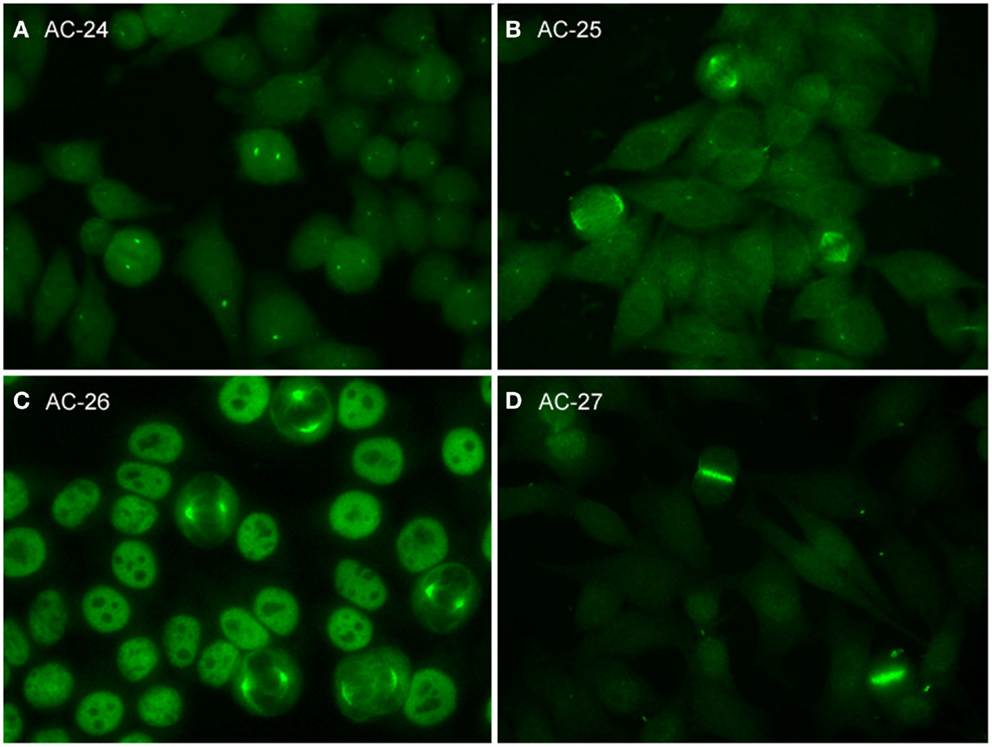
Frontiers Report of the First International Consensus on Standardized

Representative images of selected major HEp2 cell patterns. (A

Display of HEp2 cell pattern classification agreement and disagreement

Representative images of selected major HEp2 cell patterns. (A

Figure 1 from The Classification of HEp2 Cell Patterns Using Fractal

HEp2 staining patterns 1) Homogeneous 2) Nucleolar 3) Coarse Speckled
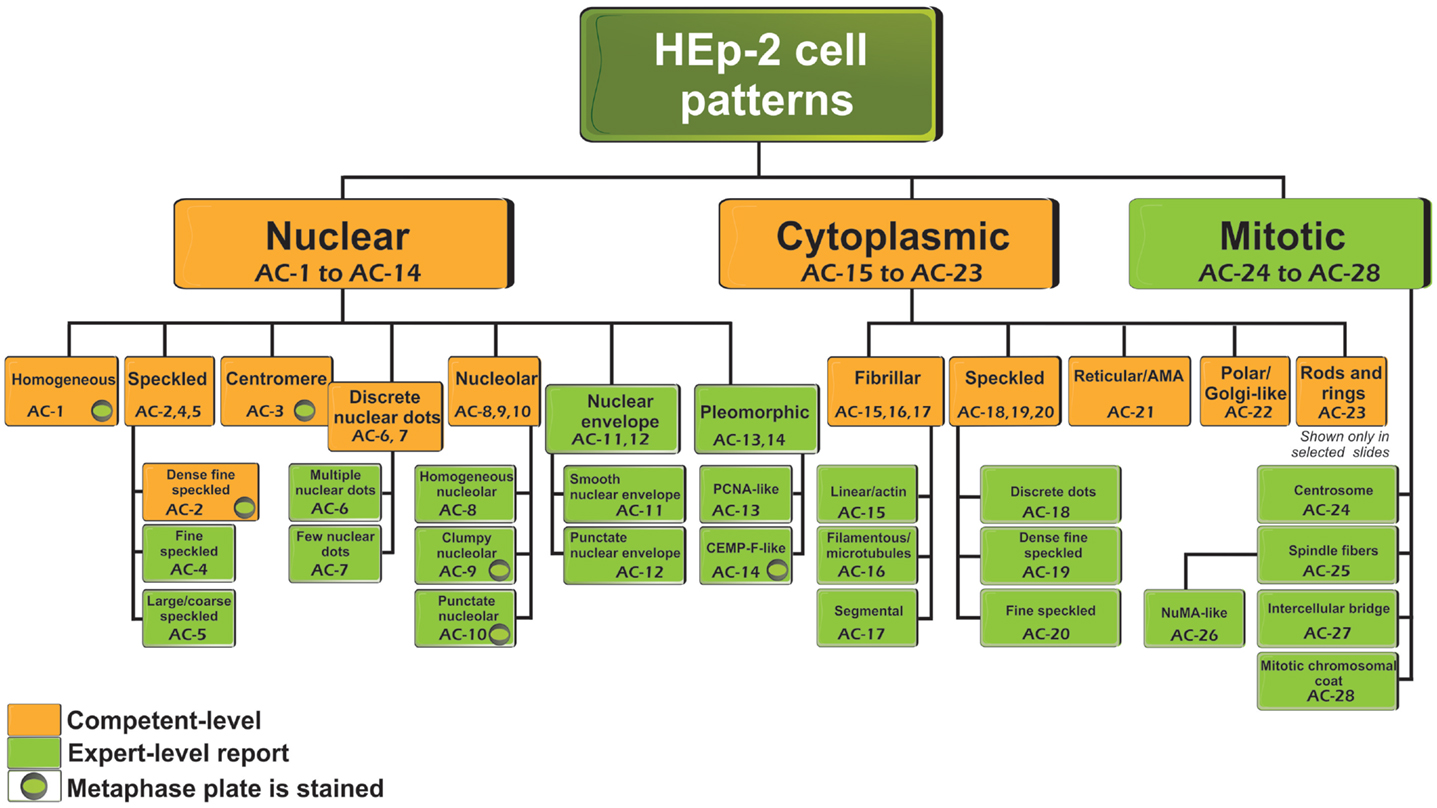
Frontiers Report of the First International Consensus on Standardized

Figure 1 from The Clinical Significance of the Dense Fine Speckled

The surface of six Hep2 cell patterns. Download Scientific Diagram

2. IFA Pattern recognition & HEp2 cell components YouTube
The Dichotomous Outcome, Negative Or Positive, Is Integrated In Diagnostic And Classification Criteria For.
Nuclear Homogeneous, Nuclear Coarse Speckled, And Nuclear Centromeric Patterns Appeared Exclusively In Patients With Ards.
Homogenous, Speckled, Centromere, Nucleolar, And Nuclear Dots.
This Clinical Relevance Is Primarily Defined Within The Context Of The Suspected Disease And Includes Recommendations For.
Related Post: